> ## Documentation Index
> Fetch the complete documentation index at: https://docs.anchorbrowser.io/llms.txt
> Use this file to discover all available pages before exploring further.
# Automation Tasks
> Create, manage, and execute reusable browser automation tasks
## Overview
The Tasks API enables you to **create, version, and execute reusable browser automation code** in your Anchor Browser sessions. Tasks allow you to:
 Tasks are executed in a secure sandbox environment and can access the full Anchor Browser API for automation capabilities.
## Creating Your First Task
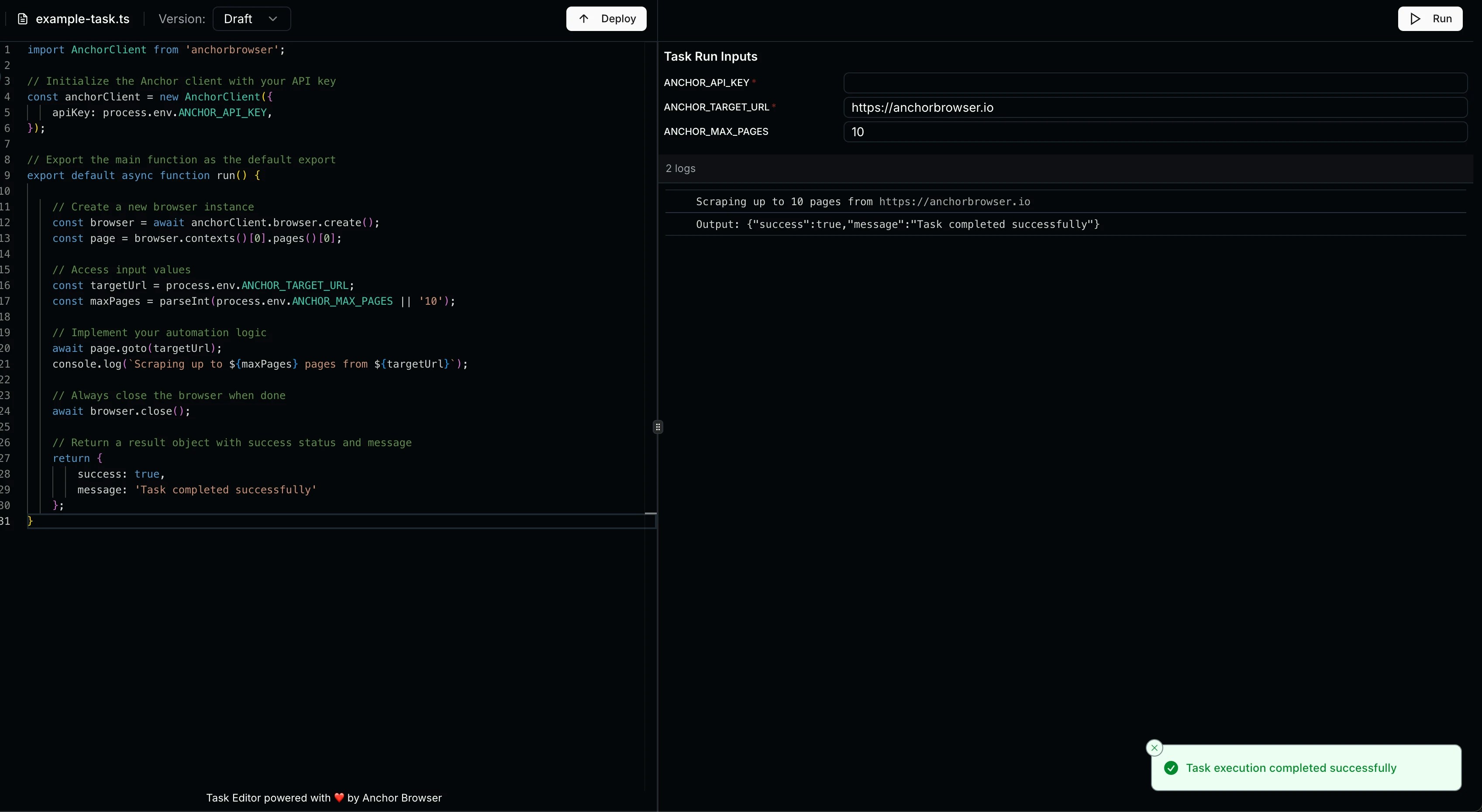
## Writing Task Code
For reliable execution, **follow these guidelines:**
* Write your **code in TypeScript.**
* **Export** a single **default async function.**
* In that function, **return** whatever your workflow requires as **output** (e.g., status, messages, domain data).
Tasks can receive values as inputs. **All input names must be prefixed with `ANCHOR_`**
### Basic Task Example
```typescript typescript theme={null}
import AnchorClient from 'anchorbrowser';
// Initialize the Anchor client with your API key
const anchorClient = new AnchorClient({
apiKey: process.env.ANCHOR_API_KEY,
});
// Export the main function as the default export
export default async function run() {
// Create a new browser instance
const browser = await anchorClient.browser.create();
const page = browser.contexts()[0].pages()[0];
// Access input values
const targetUrl = process.env.ANCHOR_TARGET_URL;
const maxPages = parseInt(process.env.ANCHOR_MAX_PAGES || '10');
// Implement your automation logic
await page.goto(targetUrl);
console.log(`Scraping up to ${maxPages} pages from ${targetUrl}`);
// Always close the browser when done
await browser.close();
// Return a result object with success status and message
return {
success: true,
message: 'Task completed successfully'
};
}
```
### Using the SDK
Create your task in Anchor:
Make sure it follows the guidelines from above.
Run the script to show your base64 file version
```bash terminal theme={null}
# Convert your TypeScript file to base64
base64 -i your-task.ts
```
Copy the output for later.
```typescript node.js theme={null}
import Anchorbrowser from 'anchorbrowser';
const client = new Anchorbrowser({
apiKey: process.env.ANCHORBROWSER_API_KEY,
});
// Create a new task
const task = await client.task.create({
name: 'example-task',
language: 'typescript',
description: 'A task to scrape product information from e-commerce sites',
code: "" // Replace with the output of the last step.
});
const taskId = task.data.id
console.log('Task created:', taskId);
```
```python python theme={null}
import os
from anchorbrowser import Anchorbrowser
client = Anchorbrowser(
api_key=os.environ.get("ANCHORBROWSER_API_KEY")
)
# Create a new task
task = client.task.create(
name="example-task",
language="typescript",
description="A task to scrape product information from e-commerce sites",
code="" # Replace with the output of the last step.
)
# Save the id for later
task_id = task.data.id
print(f"Task created: {task_id}")
```
```typescript node.js theme={null}
// Run the task with inputs
const execution = await client.task.run({
taskId: taskId,
version: 'draft',
inputs: {
ANCHOR_TARGET_URL: 'https://example.com',
ANCHOR_MAX_PAGES: '10'
}
});
console.log('Task execution started:', execution.data);
```
```python python theme={null}
# Run the task with inputs
execution = client.task.run(
task_id=task_id,
version="draft",
inputs={
"ANCHOR_TARGET_URL": "https://example.com",
"ANCHOR_MAX_PAGES": "10"
}
)
print(f"Task execution started: {execution.data}")
```
By default, the browser session is automatically closed when the task ends. Set `cleanupSessions: false` to keep the session open after task execution.
Tasks are executed in a secure sandbox environment and can access the full Anchor Browser API for automation capabilities.
## Creating Your First Task
## Writing Task Code
For reliable execution, **follow these guidelines:**
* Write your **code in TypeScript.**
* **Export** a single **default async function.**
* In that function, **return** whatever your workflow requires as **output** (e.g., status, messages, domain data).
Tasks can receive values as inputs. **All input names must be prefixed with `ANCHOR_`**
### Basic Task Example
```typescript typescript theme={null}
import AnchorClient from 'anchorbrowser';
// Initialize the Anchor client with your API key
const anchorClient = new AnchorClient({
apiKey: process.env.ANCHOR_API_KEY,
});
// Export the main function as the default export
export default async function run() {
// Create a new browser instance
const browser = await anchorClient.browser.create();
const page = browser.contexts()[0].pages()[0];
// Access input values
const targetUrl = process.env.ANCHOR_TARGET_URL;
const maxPages = parseInt(process.env.ANCHOR_MAX_PAGES || '10');
// Implement your automation logic
await page.goto(targetUrl);
console.log(`Scraping up to ${maxPages} pages from ${targetUrl}`);
// Always close the browser when done
await browser.close();
// Return a result object with success status and message
return {
success: true,
message: 'Task completed successfully'
};
}
```
### Using the SDK
Create your task in Anchor:
Make sure it follows the guidelines from above.
Run the script to show your base64 file version
```bash terminal theme={null}
# Convert your TypeScript file to base64
base64 -i your-task.ts
```
Copy the output for later.
```typescript node.js theme={null}
import Anchorbrowser from 'anchorbrowser';
const client = new Anchorbrowser({
apiKey: process.env.ANCHORBROWSER_API_KEY,
});
// Create a new task
const task = await client.task.create({
name: 'example-task',
language: 'typescript',
description: 'A task to scrape product information from e-commerce sites',
code: "" // Replace with the output of the last step.
});
const taskId = task.data.id
console.log('Task created:', taskId);
```
```python python theme={null}
import os
from anchorbrowser import Anchorbrowser
client = Anchorbrowser(
api_key=os.environ.get("ANCHORBROWSER_API_KEY")
)
# Create a new task
task = client.task.create(
name="example-task",
language="typescript",
description="A task to scrape product information from e-commerce sites",
code="" # Replace with the output of the last step.
)
# Save the id for later
task_id = task.data.id
print(f"Task created: {task_id}")
```
```typescript node.js theme={null}
// Run the task with inputs
const execution = await client.task.run({
taskId: taskId,
version: 'draft',
inputs: {
ANCHOR_TARGET_URL: 'https://example.com',
ANCHOR_MAX_PAGES: '10'
}
});
console.log('Task execution started:', execution.data);
```
```python python theme={null}
# Run the task with inputs
execution = client.task.run(
task_id=task_id,
version="draft",
inputs={
"ANCHOR_TARGET_URL": "https://example.com",
"ANCHOR_MAX_PAGES": "10"
}
)
print(f"Task execution started: {execution.data}")
```
By default, the browser session is automatically closed when the task ends. Set `cleanupSessions: false` to keep the session open after task execution.
 ```typescript node.js theme={null}
// Deploy the task to make it available for production use
const deployment = await client.task.deploy({
taskId: taskId,
code: "", // Replace with the base64 encoded code
language: 'typescript',
description: 'Optional description for this version'
});
console.log('Task deployed:', deployment.data);
```
```python python theme={null}
# Deploy the task to make it available for production use
deployment = client.task.deploy(
task_id=task_id,
code="", # Replace with the base64 encoded code
language="typescript",
description="Optional description for this version"
)
print(f"Task deployed: {deployment.data}")
```
## Async Task
By default, task execution is **synchronous** - the API call waits for the task to complete before returning results. For long-running tasks, you can use **asynchronous execution** to start the task and check results later.
### Running Tasks Asynchronously
When you set `async: true`, the API returns immediately with a confirmation that the task has started. You can then poll for execution results using the task execution history endpoint.
```typescript node.js theme={null}
// Run the task asynchronously
const execution = await client.task.run({
taskId: taskId,
version: '1',
async: true, // Enable async execution
inputs: {
ANCHOR_TARGET_URL: 'https://example.com',
ANCHOR_MAX_PAGES: '10'
}
});
console.log('Task execution started:', execution.data);
// Response: { async: true, success: true, message: 'Task execution started', taskId: '...' }
```
```python python theme={null}
# Run the task asynchronously
execution = client.task.run(
task_id=task_id,
version="1",
async_=True, # Enable async execution
inputs={
"ANCHOR_TARGET_URL": "https://example.com",
"ANCHOR_MAX_PAGES": "10"
}
)
print(f"Task execution started: {execution.data}")
# Response: {'async': True, 'success': True, 'message': 'Task execution started', 'taskId': '...'}
```
### Checking Execution Results
After starting an async task, you can check its execution status and results by querying the task's execution history endpoint:
```typescript node.js theme={null}
// Get execution results
const response = await fetch(`https://api.anchorbrowser.io/v1/task/${taskId}/executions?page=1&limit=1&version=1`, {
headers: {
'anchor-api-key': process.env.ANCHORBROWSER_API_KEY,
'Content-Type': 'application/json'
}
});
const results = await response.json();
console.log('Execution results:', results.data);
```
```python python theme={null}
import os
import requests
# Get execution results
response = requests.get(
f"https://api.anchorbrowser.io/v1/task/{task_id}/executions",
params={
# "status": "success", #Optional: filter by status (success, failure, timeout, cancelled)
"page": 1,
"limit": 1,
"version": "1" # Optional: filter by version
},
headers={
"anchor-api-key": os.environ.get("ANCHORBROWSER_API_KEY"),
"Content-Type": "application/json"
}
)
results = response.json()
print(f"Execution results: {results['data']}")
```
**Example response:**
```json theme={null}
{
"data": {
"results": [
{
"id": "550e8400-e29b-41d4-a716-446655440000",
"status": "success",
"executionTime": 5234,
"output": "{\"success\": true, \"message\": \"Task completed successfully\"}",
"errorMessage": null,
"startTime": "2024-01-15T10:30:00Z"
}
],
"pagination": {
"page": 1,
"limit": 1,
"total": 1,
"totalPages": 1
}
}
}
```
Async task executions have a maximum duration of **3 hours**. Tasks that exceed this limit will be automatically cancelled.
**Note:** Tasks must be deployed (not just in draft) to appear in the execution results list.
### Polling for Results
For async tasks, you can implement polling to wait for completion:
```typescript node.js theme={null}
// Poll for task completion
async function waitForTaskCompletion(taskId: string, maxAttempts: number = 60) {
for (let i = 0; i < maxAttempts; i++) {
const response = await fetch(`https://api.anchorbrowser.io/v1/task/${taskId}/executions?page=1&limit=1`, {
headers: {
'anchor-api-key': process.env.ANCHORBROWSER_API_KEY,
'Content-Type': 'application/json'
}
});
const results = await response.json();
const latestResult = results.data?.results?.[0];
if (latestResult) {
if (latestResult.status === 'success' || latestResult.status === 'failure') {
return latestResult;
}
}
// Wait 2 seconds before next poll
await new Promise(resolve => setTimeout(resolve, 2000));
}
throw new Error('Task execution timeout');
}
// Usage
const execution = await client.task.run({
taskId: taskId,
version: '1',
async: true,
inputs: { ANCHOR_TARGET_URL: 'https://example.com' }
});
const result = await waitForTaskCompletion(taskId);
console.log('Task completed:', result);
```
```python python theme={null}
import os
import time
import requests
# Poll for task completion
def wait_for_task_completion(task_id: str, max_attempts: int = 60):
for _ in range(max_attempts):
response = requests.get(
f"https://api.anchorbrowser.io/v1/task/{task_id}/executions",
params={"page": 1, "limit": 1},
headers={
"anchor-api-key": os.environ.get("ANCHORBROWSER_API_KEY"),
"Content-Type": "application/json"
}
)
results = response.json()
latest_result = results['data']['results'][0] if results['data']['results'] else None
if latest_result:
if latest_result['status'] in ['success', 'failure']:
return latest_result
# Wait 2 seconds before next poll
time.sleep(2)
raise Exception('Task execution timeout')
# Usage
execution = client.task.run(
task_id=task_id,
version="1",
async_=True,
inputs={"ANCHOR_TARGET_URL": "https://example.com"}
)
result = wait_for_task_completion(task_id)
print(f"Task completed: {result}")
```
## Support
For additional help with the Tasks API:
* Check the [API Reference](/api-reference/browser-sessions/start-browser-session/) for detailed tasks endpoint documentation
* Contact Anchor Browser support at [support@anchorbrowser.io](mailto:support@anchorbrowser.io)
```typescript node.js theme={null}
// Deploy the task to make it available for production use
const deployment = await client.task.deploy({
taskId: taskId,
code: "", // Replace with the base64 encoded code
language: 'typescript',
description: 'Optional description for this version'
});
console.log('Task deployed:', deployment.data);
```
```python python theme={null}
# Deploy the task to make it available for production use
deployment = client.task.deploy(
task_id=task_id,
code="", # Replace with the base64 encoded code
language="typescript",
description="Optional description for this version"
)
print(f"Task deployed: {deployment.data}")
```
## Async Task
By default, task execution is **synchronous** - the API call waits for the task to complete before returning results. For long-running tasks, you can use **asynchronous execution** to start the task and check results later.
### Running Tasks Asynchronously
When you set `async: true`, the API returns immediately with a confirmation that the task has started. You can then poll for execution results using the task execution history endpoint.
```typescript node.js theme={null}
// Run the task asynchronously
const execution = await client.task.run({
taskId: taskId,
version: '1',
async: true, // Enable async execution
inputs: {
ANCHOR_TARGET_URL: 'https://example.com',
ANCHOR_MAX_PAGES: '10'
}
});
console.log('Task execution started:', execution.data);
// Response: { async: true, success: true, message: 'Task execution started', taskId: '...' }
```
```python python theme={null}
# Run the task asynchronously
execution = client.task.run(
task_id=task_id,
version="1",
async_=True, # Enable async execution
inputs={
"ANCHOR_TARGET_URL": "https://example.com",
"ANCHOR_MAX_PAGES": "10"
}
)
print(f"Task execution started: {execution.data}")
# Response: {'async': True, 'success': True, 'message': 'Task execution started', 'taskId': '...'}
```
### Checking Execution Results
After starting an async task, you can check its execution status and results by querying the task's execution history endpoint:
```typescript node.js theme={null}
// Get execution results
const response = await fetch(`https://api.anchorbrowser.io/v1/task/${taskId}/executions?page=1&limit=1&version=1`, {
headers: {
'anchor-api-key': process.env.ANCHORBROWSER_API_KEY,
'Content-Type': 'application/json'
}
});
const results = await response.json();
console.log('Execution results:', results.data);
```
```python python theme={null}
import os
import requests
# Get execution results
response = requests.get(
f"https://api.anchorbrowser.io/v1/task/{task_id}/executions",
params={
# "status": "success", #Optional: filter by status (success, failure, timeout, cancelled)
"page": 1,
"limit": 1,
"version": "1" # Optional: filter by version
},
headers={
"anchor-api-key": os.environ.get("ANCHORBROWSER_API_KEY"),
"Content-Type": "application/json"
}
)
results = response.json()
print(f"Execution results: {results['data']}")
```
**Example response:**
```json theme={null}
{
"data": {
"results": [
{
"id": "550e8400-e29b-41d4-a716-446655440000",
"status": "success",
"executionTime": 5234,
"output": "{\"success\": true, \"message\": \"Task completed successfully\"}",
"errorMessage": null,
"startTime": "2024-01-15T10:30:00Z"
}
],
"pagination": {
"page": 1,
"limit": 1,
"total": 1,
"totalPages": 1
}
}
}
```
Async task executions have a maximum duration of **3 hours**. Tasks that exceed this limit will be automatically cancelled.
**Note:** Tasks must be deployed (not just in draft) to appear in the execution results list.
### Polling for Results
For async tasks, you can implement polling to wait for completion:
```typescript node.js theme={null}
// Poll for task completion
async function waitForTaskCompletion(taskId: string, maxAttempts: number = 60) {
for (let i = 0; i < maxAttempts; i++) {
const response = await fetch(`https://api.anchorbrowser.io/v1/task/${taskId}/executions?page=1&limit=1`, {
headers: {
'anchor-api-key': process.env.ANCHORBROWSER_API_KEY,
'Content-Type': 'application/json'
}
});
const results = await response.json();
const latestResult = results.data?.results?.[0];
if (latestResult) {
if (latestResult.status === 'success' || latestResult.status === 'failure') {
return latestResult;
}
}
// Wait 2 seconds before next poll
await new Promise(resolve => setTimeout(resolve, 2000));
}
throw new Error('Task execution timeout');
}
// Usage
const execution = await client.task.run({
taskId: taskId,
version: '1',
async: true,
inputs: { ANCHOR_TARGET_URL: 'https://example.com' }
});
const result = await waitForTaskCompletion(taskId);
console.log('Task completed:', result);
```
```python python theme={null}
import os
import time
import requests
# Poll for task completion
def wait_for_task_completion(task_id: str, max_attempts: int = 60):
for _ in range(max_attempts):
response = requests.get(
f"https://api.anchorbrowser.io/v1/task/{task_id}/executions",
params={"page": 1, "limit": 1},
headers={
"anchor-api-key": os.environ.get("ANCHORBROWSER_API_KEY"),
"Content-Type": "application/json"
}
)
results = response.json()
latest_result = results['data']['results'][0] if results['data']['results'] else None
if latest_result:
if latest_result['status'] in ['success', 'failure']:
return latest_result
# Wait 2 seconds before next poll
time.sleep(2)
raise Exception('Task execution timeout')
# Usage
execution = client.task.run(
task_id=task_id,
version="1",
async_=True,
inputs={"ANCHOR_TARGET_URL": "https://example.com"}
)
result = wait_for_task_completion(task_id)
print(f"Task completed: {result}")
```
## Support
For additional help with the Tasks API:
* Check the [API Reference](/api-reference/browser-sessions/start-browser-session/) for detailed tasks endpoint documentation
* Contact Anchor Browser support at [support@anchorbrowser.io](mailto:support@anchorbrowser.io)